Monday, March 5, 2012

February Weather Report -- More sunny, windy, dry weather

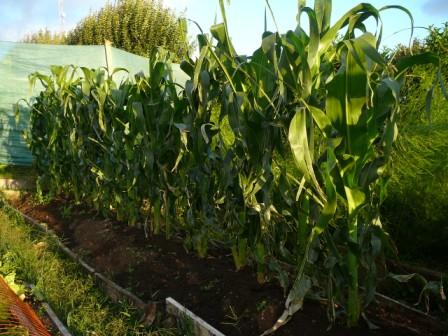
Corn, with windbreak in background
February was pretty much a rerun of January, with slightly higher temperatures. In the middle of the month there was a 16-day stretch with no measurable rain, and 23 of its 29 days were rainless. It was breezy or windy every day of the month.

All of the rain came as spray or light rain mixed with wind from the east. Of the total of 1.5 inches of rain, .9 inches fell in one single day, Feb. 8.

The average high was 77.1 degrees; the average low -- 59.7. Trade winds coming down from the mountains kept temperatures moderate throughout, with the highest temperature of 82 degrees on February 19 and the lowest of 58 on various dates.

The two windbreaks in the vegetable garden continued to hold up, and we added a new section to protect a new section of corn plants. The humidity was low and the fruits and vegetables were completely disease free.

Happy gardening!

Wednesday, February 8, 2012

January Weather Report -- Break out the sunscreen

January was the sunniest, windiest, and driest month on record (since record-keeping began almost two years ago). Looking over my daily weather descriptions I see it was sunny or mostly sunny for 25 of January's 31 days. As for rain, we received a measly 1.3 inches. We also experienced the longest stretch of days with no measurable rainfall: 17 days (from Jan. 16 till Feb. 1). The trade winds blew almost constantly, and I recorded a record-breaking gust of 42 miles per hour on January 29. By mid-month cracks began to appear in our very clayey soil.

The ground cracked open.

Highs were slightly higher and lows slightly lower than in December: the average high was 74.9 degrees; the average low -- 58.8.

With all this sunny weather I've had to use lots of sunblock on my arms, face, and neck. I also wear a broad-brimmed straw hat.  The wind keeps the temperature and humidity down, so on windy days I can work outside with a long-sleeve shirt till mid-morning.

The good news is that many flowers (such as the hibiscus) put out most of their blooms during the dry season. Also, the lawn needs mowing less frequently.

I have spent a lot of time watering. Last year a friend offered to show me how to install a drip irrigation system, but I turned him down because my first two dry seasons here weren't really very dry at all. I am hand-watering now, and wishing I had that drip system.

The pond has also turned murky and bright green with algae. Once or twice a week I top it up with tap water and also occasionally let several hundred gallons flow out in order to clear the water some. I am working on a home-made biological filter and hope to install it soon.

The two windbreaks in the vegetable garden are functioning well (last January there were no windbreaks and the wind destroyed everything).

If one is willing to spend the time and money watering vegetables, the dry season is an excellent time to grow them.

Happy gardening!

Friday, January 20, 2012

The Greenhouse: part 2


When my handyman, don Alexis, built the greenhouse I knew it needed a long counter to put the plants on, but I didn't have the funds at the time to have him complete the job. There were some small shelves built into the wall, so I decided to make do with them.

Now that I've learned a lot more about growing plants in a greenhouse, and I have the funds, I had don Alexis build the counter. He did a nice job. It's made of steel tubing to which he welded heavy-duty wire. It's painted with rust-proof paint and is strong enough to hold a lot of weight.

I've started some tomato plants now, and plan to continue to fill up the long, 35-foot counter with plants.

Happy gardening!

Friday, January 6, 2012

2011 Weather in Review

Windbreaks constructed in December to protect the vegetable garden

RAINFALL
I am continually amazed by the amount of rainfall we receive here. The total for the year was 129.9 inches. The average annual rainfall recorded at a weather station only about three miles away is 90 inches. So we got 40 inches above the normal. WOW!

We are not experiencing either an El Niño nor a La Niña, so the rainfall and temperatures should be about average. The two factors that could conceivably account for the high rainfall are either yearly variability or very localized weather conditions. It could be a combination of both factors, but I'm guessing it's more the effects of the localized weather. Time will tell.

Monthly rainfall (in inches)
  January           6.8
  February         6.1
  March            3.7
  April              4.5
  May             18.1
  June             10.9
  July              15.5
  August           6.0
  September   11.1
  October       33.3
  November     7.7
  December      6.2

   TOTAL      129.9

The distribution of rainfall by month for 2011 seems about right. The dry season (or summer, as it is called here) usually begins in December and lasts through April. The rainy season (or winter, as it is called here) usually begins in May and lasts through November. The only month that did not fit this pattern this year was August.

TEMPERATURES
It felt warmer this year, and the data bears this out. Comparing the last five months of 2010 (when I began keeping data) with the last five of 2011, every month was warmer in 2011, one month even seven degrees warmer, farenheit.

Temperatures by month
                  Ave. high  Ave. low
  January          77.6      60.5
  February       76.6      58.1
  March           78.2      58.1
  April             78.7      60.3
  May              78.0      62.1
  June              78.0      63.1
  July               78.3      63.5
  August          80.0      64.3
  September    79.6      63.8
  October        75.4      63.1
  November     77.2      61.3
  December     74.4      59.7

WIND, HUMIDITY, AND BAROMETRIC PRESSURE
I do not yet have the instruments to measure humidity or barometric pressure. During the dry season, the trade winds are blowing over the top of the Cordillera Central. We are located just a few miles from the top of this mountain range, on the leeward side. These cross-mountain winds keep the temperatures moderate, and the humidity down for much of the year.

For wind velocity, I have a hand-held anemometer. As this is the first really windy place I have lived, I've been interesting in measuring the maximum wind velocity. The windy season corresponds roughly with the dry season, and the trade winds are the dominating force. The winds generally begin in November, a month before the dry season begins, and blow until March, ending a month before the wet season begins, in May.
The maximum recorded wind gust was 34 miles per hour, which occurred in February.

Happy gardening!

Monday, January 2, 2012

December Weather Report -- sunny, windy, and cool

December was sunny, windy, and cool. The trade winds blew almost constantly from the east-northeast, the maximum gust reaching 25 miles per hour. I don't keep statistics on sunshine, but it was the sunniest month I can remember since arriving here in July 2009. Despite the sunshine, spray-rain lashed us frequently, creating rainbows in the west in the mornings and in the east during the afternoons.

Rainfall came to 6.2 inches. We had 19 days with no measurable rainfall. The sun and high winds dessicated the soil rapidly and I had to water the vegetable garden many times. I put up a windbreak on the east side of the vegetable garden at the beginning of the month and added a second one in the middle of the garden on Christmas eve. A two-year-old cypress tree snapped off in the wind and I had to stake several small trees.


A blue-gray tanager that crashed into one of our windows. After nursing it back to health, we released it.

The average high was 74.4 degrees, the lowest this year, and down 2.2 degrees from November. The average low was 59.7, a little cooler than normal here.

Happy gardening!

Saturday, December 31, 2011

Calla Lilies

One of the flowers I'd been looking forward to growing in Costa Rica were calla lilies (Zantedeschia aethiopica). I knew very little about them, other than the fact that they grew in the tropics in areas with relative cool temperatures. Upon arriving we received a few bulbs from relatives and we stuck them in the ground in various places, none of which had very good soil. They didn't do well.

My wife said they liked damp soil, so a year ago we put some in a pot with good soil, and placed it in our new fish pond. The bulbs were just an inch or two above water level. They didn't do well either. Probably too much water.

I looked up calla lilies in two tropical gardening books that I'd recently acquired. GARDENING IN THE CARIBBEAN did not even mention calla lilies. I found this puzzling at first, but now realize that it logically would not include them because it only covers plants that grow in hot and/or warm climates. GARDENING IN THE TROPICS treated them only very briefly, and stated, ". . . best grown in plenty of light, but not in direct sunlight." When I told my wife this, she said, "Well, the book is wrong because in Costa Rica they are grown in direct sunlight."

I eventually looked up calla lilies on the internet and discovered information that verified my wife's take on sunlight. They do like direct sunlight.

Okay, so about this time we needed to create a series of catchment basins for the
water that ran out of our fish pond during heavy rains. Lots of water (but not too much), plenty of good soil, and direct sunlight -- maybe I could make a catchment basin that would be the perfect spot for calla lilies. So, I dug up an area just downhill from the exit pipe from the fish pond, worked in some sand and lots and lots of compost, and created two gutters exiting from the new basin so that excess water would run out. Next I took the pot of callas from the pond, divided the bulbs, and planted them in the new basin.

Within a couple of weeks we noticed that the plants were putting out dark green stems
and leaves that were much thicker and healthier than they were when they were in the pond. Within a six weeks we had our first blooms, and they have continued to thrive, multiply, and put out masses of blooms for four months now.


In October we got 33 inches of rain, and it seemed to rain almost the entire month, nonstop. At times the calla bulbs were under two to three inches of water for up to five or six hours at a time. But the excess water ran off and the rest soaked in. The callas just love their new environment. I have continued to add compost (and compost tea when they are dry). They, and we, couldn't be happier.

I've noticed that our callas only grow to be about 15 inches tall. The cut calla lilies that I see in the market are about two feet tall. They are grown at higher elevations than our lot. So, I assume that it is the cooler weather that they thrive on.

Happy gardening!

Tuesday, December 27, 2011

Pecking Order

We love to watch the birds in our garden. They are totally different from the ones we had in our garden in South Carolina, with the one exception of the house wren. The house wren here, however, is a different subspecies, and sings more sweetly than the one on South Carolina.

After two years of observation we have learned a lot about the birds. One of the biggest differences is that many of the birds here are nectar and fruit eaters. In South Carolina we put out mostly seeds, and ocassionally some suet. We tried putting out fruit a couple of times, but only succeeded in attracting butterflies and wasps. Here in Costa Rica, 16 out of the 78 species we have on our property are fruit and/or nectar eaters. We have two platform feeders where we put plantains, and sometimes bananas or papayas.

There is a lot of competition among the birds for the fruit. Some bird species tolerate other species at the feeder; other species will chase off any other birds. Over time we have figured out the pecking order, i.e., which birds dominate other birds. The order seems to be determined by a combination of size, size and shape of bill, and personality.
Blue-crowned motmot

Ironically, at the top and bottom ends of the pecking order are the two largest birds. The blue-crowned motmot is the uncontested king of the feeder. When it lands there, all other birds make a beeline for the bushes, where they remain until the motmot has had its fill and eventually lumbers off with a full belly. Although motmots are fairly sedentary birds and seemingly nonaggressive, they have long, vicious-looking bills, and will sometimes peck at other birds that try to land on the feeding platform. Motmots sometimes stay at the feeder for a half hour or more, resting between feeding sessions. If this goes on long enough, the birds in the bushes become wrestless and the clay-colored thrushes in particular begin to buzz the feeder, being careful to stay just out of pecking distance.

Near the bottom of the pecking order are the red-billed pigeons, which weigh almost twice as much as the motmots (the pigeons weigh 230 grams; the motmots, 120 grams). The pigeons have very small bills in relation to their size, and a very passive personality. They wait on top of our poro tree and watch the feeder till the morning feeding frenzy is over. Then they descend en masse on the feeder.


Male Hoffmann's Woodpecker (photo courtesy of R. Hays Cummins)
After the motmot comes the Hoffman's woodpecker. It is a medium-sized bird, but has a long, sharp and powerful bill. It is willing to share the feeding platform with other birds, but if challenged (which is usually by a thrush) will quickly drive the other bird off. It is kind of like Teddy Roosevelt -- it walks softly, but carries a big stick.

Next come the clay-colored thrushes (until recently called clay-colored robins) and the Baltimore orioles. There are lots of thrushes and they are around the feeder all day bullying the other birds to no end. The orioles are aggressive when they are here, which is only part of the year. They chase off most other birds, but seem to delight in squaring off with the thrushes. The thrushes usually stand their ground at first, but the orioles generally win out in the end.

Great Kiskadee
Great kiskadees come next in the pecking order and also fight a lot with the thrushes. Black-headed saltators follow. If at the feeder singly, they cannot stand up to a thrush, so what they do a few times a day is they come in as a family of four to six birds and take over the feeder. Not even a motmot can stand up to a mob like that.

The kiskadees and black-headed saltators are followed in the pecking order by a motly crew of grayish saltators, flame-colored tanagers, summer tanagers, and ocassionally hepatic tanagers. At times they will squabble among themselves, but they are basically non-aggressive birds.


Summer Tanager
Below these are blue-gray tanagers and Tennessee warblers. These birds almost always come in pairs. The blue-gray tanager seems to be a friendly bird and is generally not bothered by the other birds, with the exception of the thrushes. The Tennessee warblers just started showing up this year. They will land on the feeder when any other type of bird is feeding, with the exception of the motmots, and dart in to to peck at the plantain, and then quickly back out again.

We also have three species of hummingbirds, but they do not eat fruit, only nectar, so do not come to the platform feeder.

Happy gardening!